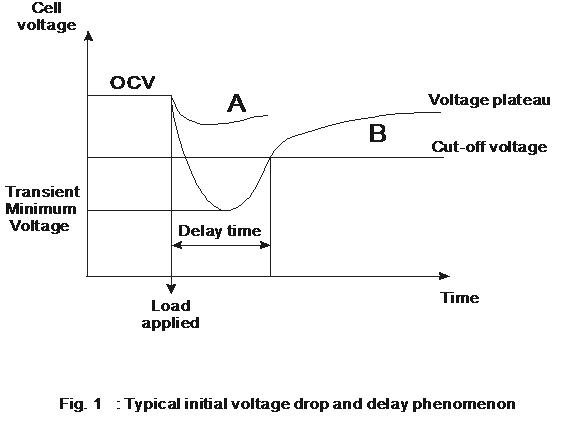
1. Parameters characterising the voltage delay of lithium thionyl chloride batteries
Transient Minimum Voltage (TMV): the lowest battery voltage when a certain load current is applied to the battery;
Time Recovering to STable Voltage (TRSV): the time required for the battery load voltage to recover to its normal value;
2. Relationship between TMV / TRSV and storage time
The following two figures show how TMV and TRSV change with storage time:
3. Relationship between TMV and battery internal resistance
The relationship between TMV and the battery internal resistance follows the general voltage-resistance relationship of a circuit, as shown below:
E-TMV=I*r or TMV=E-I*r
where: E is the battery electromotive force, which for lithium thionyl chloride batteries is always 3.66 to 3.68 and remains constant until the metallic lithium in the battery is used up;
I is the discharge current;
r is the battery internal resistance.
The battery internal resistance consists of the following parts:
a. contact resistance between the parts inside the battery;
b. ohmic resistance of each component of the battery;
c. transport resistance of lithium ions inside the electrolyte;
d. transport resistance of lithium ions inside the passivation film on the surface of the metallic lithium negative electrode;
e. polarisation resistance of the battery electrochemical system.
Among these, items a and b are basically fixed; c varies with the current and the temperature - the larger the current the larger the transport resistance, and the higher the temperature the smaller the resistance; the polarisation resistance e mainly depends on temperature and depth of discharge - the higher the temperature the smaller the polarisation resistance, and the deeper the discharge the larger it becomes; the ion transport resistance in the passivation film d depends on the thickness of the film, the thicker the film the larger the resistance, in an approximately proportional relationship.
The thickness of the passivation film is in turn directly related to the battery storage temperature: the higher the storage temperature, the thicker the passivation film, and the lower the corresponding TMV of the battery.
4. Relationship between voltage delay and battery self-discharge
Since the passivation film is produced by the reaction of the positive active material, thionyl chloride, with metallic lithium, the passivation process (that is, the delay process) consumes part of the battery capacity, and this consumed capacity is also the main component of battery self-discharge. Of course, battery self-discharge also includes the capacity consumed by the small discharge current caused by the ohmic resistance between the positive and negative electrodes.
If there are strictly no other substances in the battery, the passivation film formed inside it becomes thicker and thicker with storage time, but a thicker passivation film prevents the reaction between thionyl chloride and metallic lithium. In other words, the formation rate of the passivation film gradually decreases with storage time and the capacity consumption also gradually decreases. Such a battery therefore has a severe voltage delay but an extremely low self-discharge rate, possibly below 0.5% per year; however, because the voltage delay is severe its application is greatly restricted and it cannot meet the requirement when a certain current pulse is needed.
Today every manufacturer adds some chemical additives to the battery that can slow down the formation of the passivation film to a certain extent, so that the film does not grow too thick and the battery can supply a pulse current of a certain magnitude. Because the passivation film is not too thick, the self-discharge rate is a little higher, about 2%. In short, the self-discharge rate of a battery is related to its voltage delay: a severe voltage delay corresponds to a lower self-discharge rate.