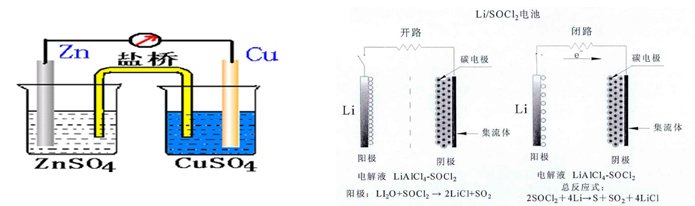
At the Anode:
4Li-----4Li+ +4e-
At the Cathode:
2SOCl2-----SO2+S+4Cl--4e-
Overall:
4Li+2SOCl2----> Lithium-ion batteries are common in consumer electronics, with one of the best energy-to-weight ratios, no memory effect, and a slow loss of charge when not in use. In addition to uses fo-4LiCl+S+SO2
Most of the SO2 formed during cell discharge is dissolved in the electrolyte and cathode. This accounts for the low internal cell pressure before, during and after normal discharge.
GREEN ENERGY BATTERY Lithium Thionyl Cies are technological evolution from lithium-ion batteries. The primary difference is that the lithium-salt electrolyte is not held in an organic solvent but in a solid polymer composite such as polyethylene oxide or polyacrylonitrile.
The advanhloride (Li/SOCl2 ) Cells Feature:
High Energy Density-----Lithium Thionyl Chloride cells offer the highest energy density of any primary cell, up to 710Wh/kg.
Higher Capacity-----Li/SOCl2 cells feature the highest capacity by weight and volweight and size benefits of Li-ion but are proven to be far safer in critical situations; coupled with a working life of 1,000 charging cycles, double that of other battery types.
Operating principles of rechargeable lithium battume compared to any known battery technology
Higher Operating Voltage-----Lithium Thionyl Chloride cells have an open circuit voltage of 3.67V and an operating voltage of up to 3.6V, a considerably high voltage than almost any other primary cell.
Long Operating Life and shelf life-----The self-discharge of Li/SOCl2 Batteries are extremely low ( less than 2% per year at 20 ), which can support long storage periods and achieve a service life of 10 to 20 years.
Environmentally Friendly-----our batteries are free of heavy metals
Hermetically sealed case-----The hermetically sealed case is essential for the long shelf life and inherent safety of the devices in which the batteries are used. The cover is welded to the can. A glass-to-metal seal is used to insulate the positive terminal. A safety vent is used on the negative terminals for spiral type.
Bobbin Type vs Spiral Type
Two type of lithium thionyl chloride cells are available: bobbin and spiral wound construction. Bobbin type cells are particularly well suited for low self-discharge rate, and 10 to 20 years storage life. High capacity, small size, and ability to with stand broad fluctuations in pressure, temperature and shock make bobbin type cells ideal for use in remote monitoring applications. However, a growing number of applications require high current pulses. Spiral type cells are ideal for high pulse current applications. In addition, there is small impedance for spiral type. ("M" stands for spiral type in our part number)
Working Principle